Talent Acquisition leaders across the US were surveyed on AI adoption, what it means for team structure, and how they see talent acquisition evolving. The results show that most teams are using AI, but few are using it to its potential, at least not yet. How are leaders managing their teams through this tidal wave technology advancement, and what does that mean for the near future of Talent Acquisition.
01
The ATS Transition: From Action to Record
65% of leaders say their stack is "mostly adequate"
The ATS works, but it wasn't built for today's hiring environment, mass applicants, fake AI candidates, and new extensions arriving weekly. 22% say it's limited in key areas. "Adequate" means it processes requisitions, tracks candidates, and moves approvals.
Leaders know their ATS has limitations. They are weighing those limitations against the organizational cost of change, and for now, adequacy wins.
As AI assumes responsibility for the functions the ATS was never great at, the ATS transitions from a system of action to a system of record while it becomes less relevant in its current state.
02
AI Adoption Is Real
Nearly all respondents have adopted some form of AI, but almost entirely at the lowest tier: writing assistance, scheduling support, and summarization.
A smaller group of TA Leaders (~25%) have crossed into task automation and agentic automation. This includes AI handling screening, sourcing, or routing with minimal human intervention, and performing sequences of tasks autonomously.
AI adoption in TA is not driven by company size or industry. It is driven by organizational risk tolerance.
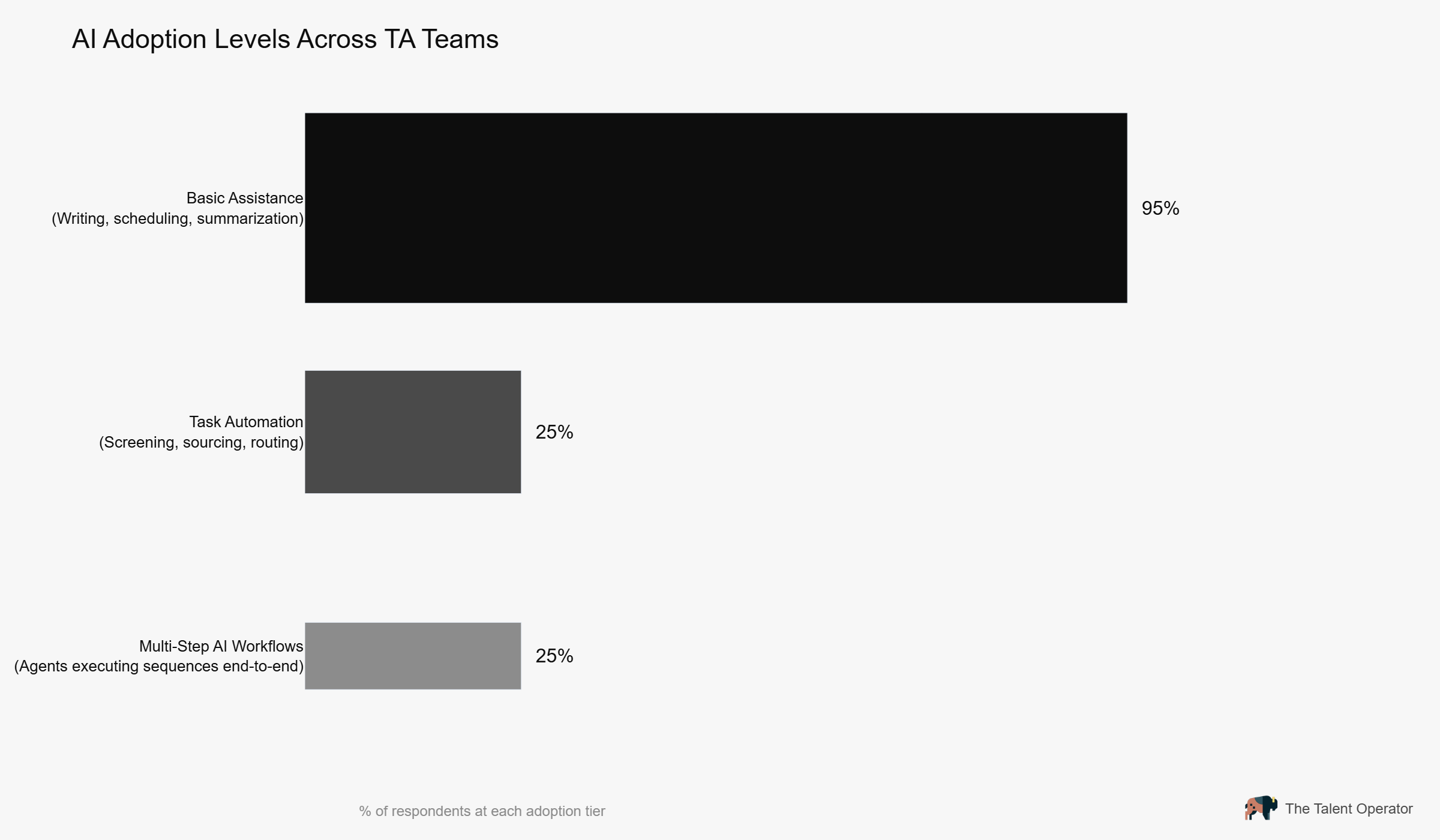
AI Adoption Levels Across TA Teams
03
The Compliance Brake: Why Data Privacy is the Real Bottleneck
65% cite security, privacy, or compliance concerns as their primary barrier
Leaders know what the technology can do. They want to move faster with better insights, but organizations are pumping the brakes, and for sound reasons.
Talent Acquisition processes highly sensitive candidate data: names, contact information, interview feedback, employment histories, and compensation data. The introduction of AI into this data environment raises questions that most enterprise legal and privacy functions are still working through.
55% additionally cite IT and procurement restrictions, not as obstacles thrown up by difficult colleagues, but possibly as the natural output of organizations that were never designed to govern technology that moves this fast.
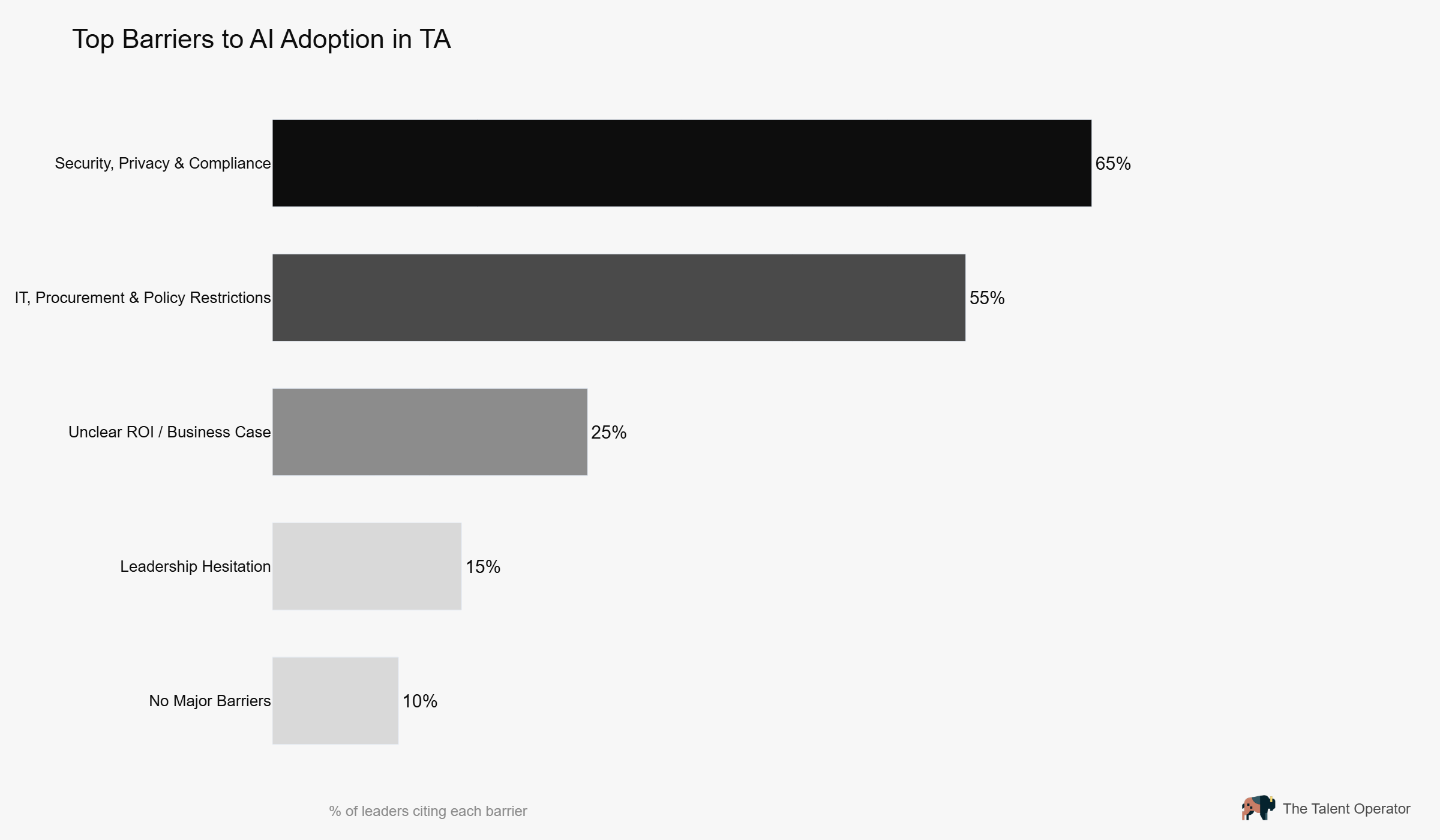
Top Barriers to AI Adoption in TA
04
AI Will Shrink TA Teams, But Leaders Are Split
No consensus on headcount impact, except one: nobody expects growth.
Leaders already running lean have less to protect and clearer visibility into what AI is actively absorbing. The leaders forecasting moderate to significant reduction (~40%) share a notable characteristic: they are predominantly operating in properly staffed, technology forward TA teams, typically early and growth stage companies with leaner, more modern tech stacks, with direct visibility into which tasks AI is replacing.
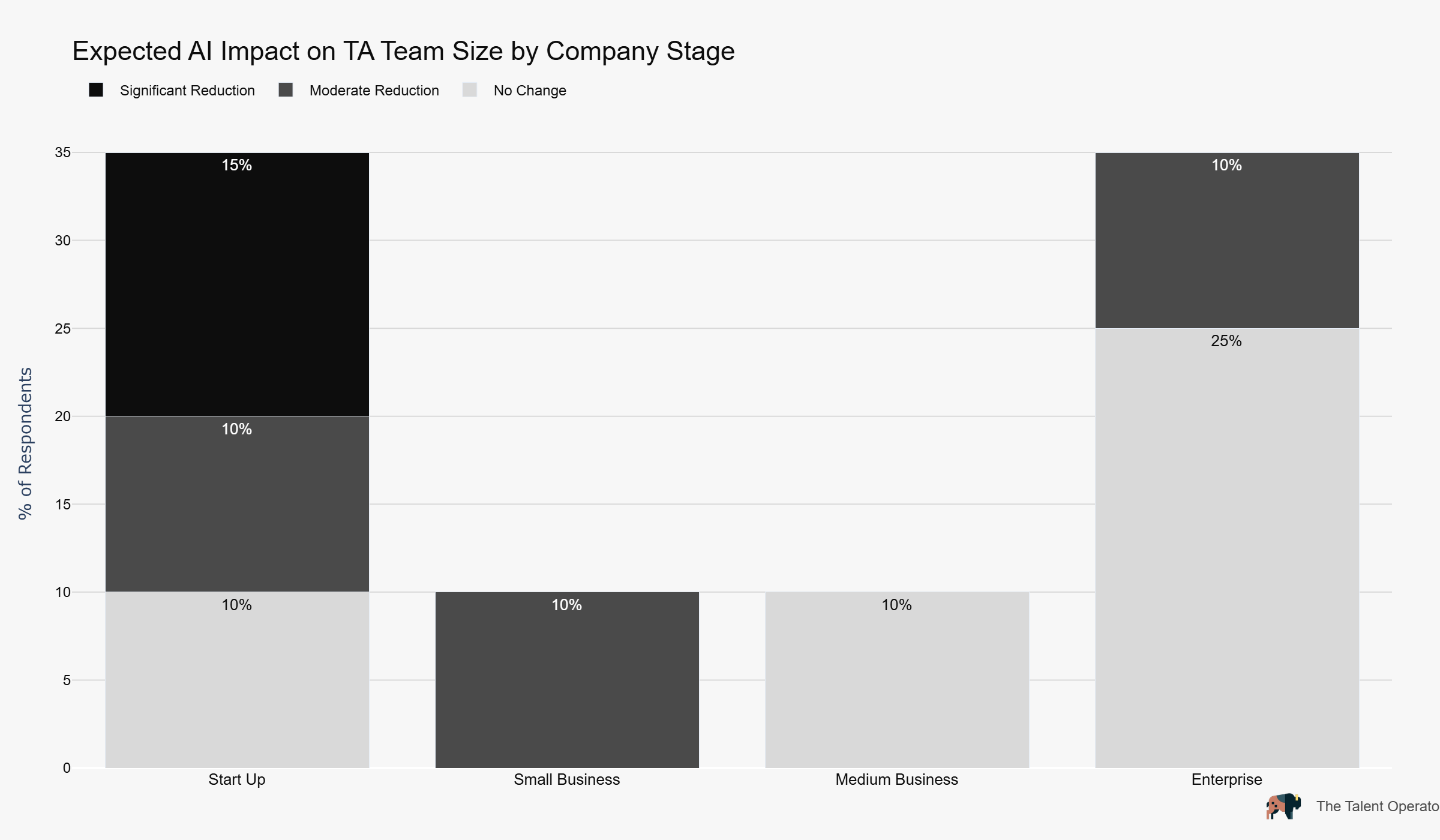
Expected AI Impact on TA Team Size by Company Stage
05
The New TA Skillset: Redefining Value in the AI Era
Leaders see TA evolving in multiple directions at once. The middle layer of recruiting is predicted to disappear.
01
People Data Fluency
TA needs to think beyond filling seats and how hiring decisions will affect organizational health with data rather than assumptions.
02
Org Effectiveness
Using data to understand team composition and identify what kind of candidate fits the role and the dynamic around it.
03
Human Assessment Depth
Screening beyond skills, leadership compatibility, team dynamics, psychological patterns, motivational drivers, with data behind the instinct.
75% more strategic & consultative65% more technical
AI will generate an unprecedented volume of data. The TA leader and talent operators of the next decade will need to make sense of complex human data and translate it into hiring decisions.
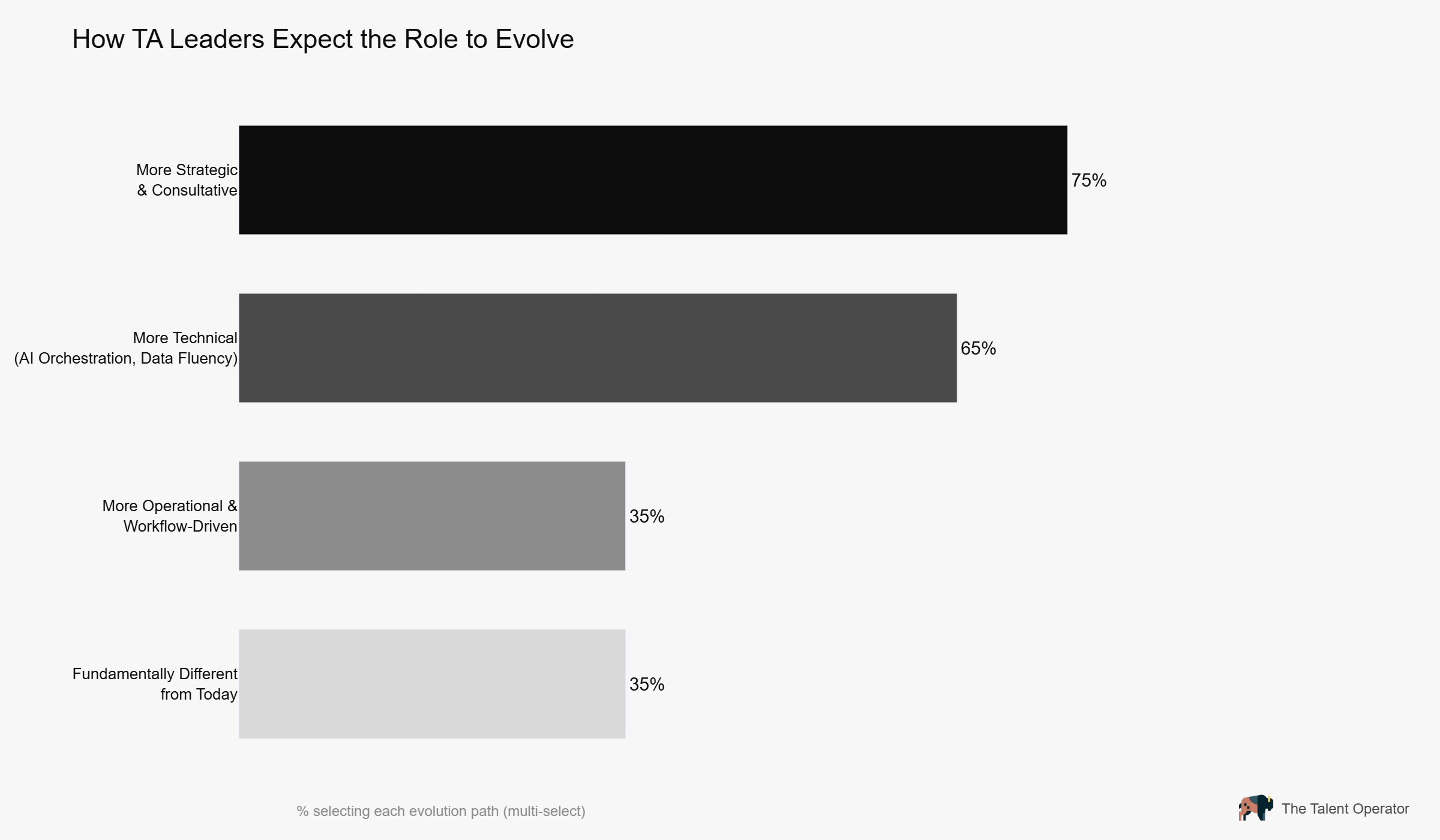
How TA Leaders Expect the Role to Evolve
06
What Leaders Are Actually Focused On
TA teams require more from technology to withstand the massive applicant volume. Leaders are justifying tech investments and enhancements from tight budgets and overworked tech teams, while trying to justify investment in systems too unreliable to produce clean numbers. Meanwhile the outside world did not wait for TA to get its house in order. Candidates are gaming the job application with autonomous submissions, AI generated resumes, AI video and more.
~65% are prioritizing AI tools and automation: an active implementation effort.
~55% are focused on technology consolidation: rationalizing a stack that has grown too large.
~45% are prioritizing process redesign: recognizing that AI doesn't fix broken workflows.
Implications
What This Means for You Now
TA leaders who will define the next era are the ones who learn to own what AI produces. When agentic systems handle the transactional work, the practitioner's entire value proposition shifts to interpretation.
When the majority of the market adopts the same tools, applies the same logic, and optimizes for the same signals, the competitive advantage those tools were supposed to create disappears. The differentiation won't come from having AI. It will come from how intelligently you use it.